










Most babies can change to a new formula without any problems.
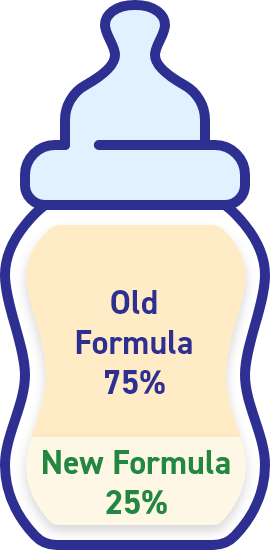
Follow the transition schedule below to help gradually switch your baby to a new formula. The transition can be made over 4 days with less than a can of formula.
Talk to a WIC Nutritionist if you have concerns about switching your baby’s formula.

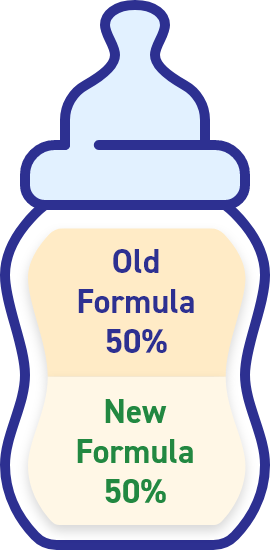
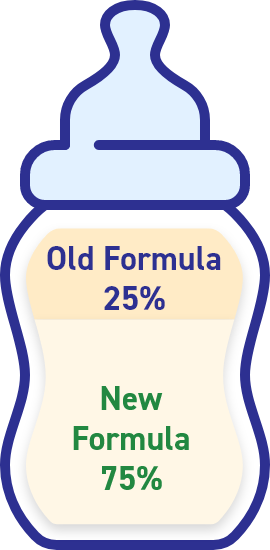

| Preparing a 4 oz Bottle | Preparing a 6 oz Bottle | Preparing a 8 oz Bottle | |
|---|---|---|---|
| Day 0 |
 Use:
4 oz old brand of formula
|
 Use:
6 oz old brand of formula
|
 Use:
8 oz old brand of formula
|
| Day 1 |
 Mix:
3 oz old brand of formula
1 oz new brand of formula
|
 Mix:
4 oz old brand of formula
2 oz new brand of formula
|
 Mix:
6 oz old brand of formula
2 oz new brand of formula
|
| Day 2 |
 Mix:
2 oz old brand of formula
2 oz new brand of formula
|
 Mix:
3 oz old brand of formula
3 oz new brand of formula
|
 Mix:
4 oz old brand of formula
4 oz new brand of formula
|
| Day 3 |
 Mix:
1 oz old brand of formula
3 oz new brand of formula
|
 Mix:
2 oz old brand of formula
4 oz new brand of formula
|
 Mix:
2 oz old brand of formula
6 oz new brand of formula
|
| Day 4 |
 Use:
4 oz new brand of formula
(Transition is completed)
|
 Use:
6 oz new brand of formula
(Transition is completed)
|
 Use:
8 oz new brand of formula
(Transition is completed)
|
 4 oz Bottle 4 oz Bottle |  6 oz Bottle 6 oz Bottle | |
|---|---|---|
| Days 1 & 2 |  Prepare 6 oz of old formula and 2 oz of new formula according to the directions on each can.  In a 3rd bottle, mix together 3 oz of old formula with 1 oz of new formula. Combine the remaining prepared formula and save it in the refrigerator for the next feed. | 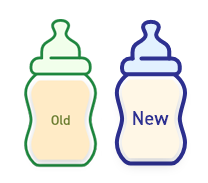 Prepare 8 oz of old formula and 4 oz of new formula according to the directions on each can.  Mix together 4 oz of old formula with 2 oz of new formula. Combine the remaining prepared formula and save it in the refrigerator for the next feed. |
| Days 3 & 4 |  Prepare 4 oz of each formula according to the directions on each can. 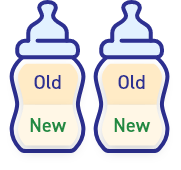 Mix together and evenly divide into 2 bottles; save one of the mixed bottles in the refrigerator for the next feed. | 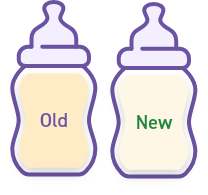 Prepare 6 oz of each formula according to the directions on each can.  Mix together and evenly divide into 2 bottles; save one of the mixed bottles in the refrigerator for the next feed. |
| Days 5 & 6 | 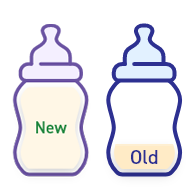 Prepare 6 oz of new formula and 2 oz of old formula according to the directions on each can.  Mix 3 oz of the new formula with 1 oz of the old formula; save one of the mixed bottles in the refrigerator for the next feed. | 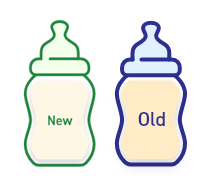 Prepare 8 oz of new formula and 4 oz of old formula according to the directions on each can. 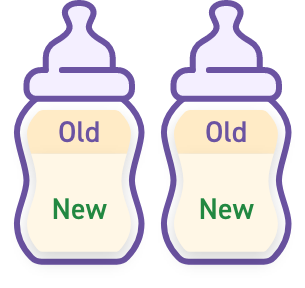 Mix 4 oz of new formula with 2 oz of old formula; save one of the mixed bottles in the refrigerator for the next feed. |
| Day 7 |  Prepare 4 oz of new formula according to the directions on can. (Change is completed) |  Prepare 6 oz of new formula according to the directions on can. (Change is completed) |
| 4 oz Bottle | 6 oz Bottle | |
|---|---|---|
| Days 1 & 2 | Prepare 6 oz of old formula and 2 oz of new formula according to the directions on each can. In a 3rd bottle, mix together 3 oz of old formula with 1 oz of new formula. Combine the remaining prepared formula and save it in the refrigerator for the next feed. | Prepare 8 oz of old formula and 4 oz of new formula according to the directions on each can. Mix together 4 oz of old formula with 2 oz of new formula. Combine the remaining prepared formula and save it in the refrigerator for the next feed. |
| Days 3 & 4 | Prepare 4 oz of each formula according to the directions on each can. Mix together and evenly divide into 2 bottles; save one of the mixed bottles in the refrigerator for the next feed. | Prepare 6 oz of each formula according to the directions on each can. Mix together and evenly divide into 2 bottles; save one of the mixed bottles in the refrigerator for the next feed. |
| Days 5 & 6 | Prepare 6 oz of new formula and 2 oz of old formula according to the directions on each can. Mix 3 oz of the new formula with 1 oz of the old formula; save one of the mixed bottles in the refrigerator for the next feed. | Prepare 8 oz of new formula and 4 oz of old formula according to the directions on each can. Mix 4 oz of new formula with 2 oz of old formula; save one of the mixed bottles in the refrigerator for the next feed. |
| Day 7 | Prepare 4 oz of new formula according to the directions on can. (Change is completed) | Prepare 6 oz of new formula according to the directions on can. (Change is completed) |
| 4 oz Bottle | 6 oz Bottle | |
|---|---|---|
| Days 1 & 2 | Prepare 6 oz of old formula and 2 oz of new formula according to the directions on each can. In a 3rd bottle, mix together 3 oz of old formula with 1 oz of new formula. Combine the remaining prepared formula and save it in the refrigerator for the next feed. | Prepare 8 oz of old formula and 4 oz of new formula according to the directions on each can. Mix together 4 oz of old formula with 2 oz of new formula. Combine the remaining prepared formula and save it in the refrigerator for the next feed. |
| Days 3 & 4 | Prepare 4 oz of each formula according to the directions on each can. Mix together and evenly divide into 2 bottles; save one of the mixed bottles in the refrigerator for the next feed. | Prepare 6 oz of each formula according to the directions on each can. Mix together and evenly divide into 2 bottles; save one of the mixed bottles in the refrigerator for the next feed. |
| Days 5 & 6 | Prepare 6 oz of new formula and 2 oz of old formula according to the directions on each can. Mix 3 oz of the new formula with 1 oz of the old formula; save one of the mixed bottles in the refrigerator for the next feed. | Prepare 8 oz of new formula and 4 oz of old formula according to the directions on each can. Mix 4 oz of new formula with 2 oz of old formula; save one of the mixed bottles in the refrigerator for the next feed. |
| Day 7 | Prepare 4 oz of new formula according to the directions on can. (Change is completed) | Prepare 6 oz of new formula according to the directions on can. (Change is completed) |


Be patient and give your baby time to adjust. It can take about one to two weeks for their tummy to get used to the new formula.

Your baby may burp or spit up a little while changing to the new formula.

Every formula tastes different; if your infant tried the new formula and did not like it, try changing the formula more slowly.

Your baby’s poop may look or smell different when changing formulas; this is normal.

Carefully read and follow the mixing instructions on the formula label.

Use a safe water source to mix your infant formula.


Never prop up the bottle to feed baby or add cereal to the bottle (this can cause choking or overeating.)

Never use homemade infant formula. It lacks the correct balance of vitamins and nutrients your baby needs to grow and thrive. An incorrect balance can lead to serious health problems like seizures or brain swelling, and can even be fatal.


Install this web app on your iPhone: tap and then Add to Home Screen.


Share to Social
Share this link via